You’ve likely heard the horrors of pesticides in produce and that you should buy organic whenever is possible.
But for most of us, unless you are a trust fund baby, or willing to spend your child’s college fund at Whole Foods, that just may not be possible.
The good news is, that may not even be necessary!
Yes, that’s right, some things you don’t need to worry about buying organic.
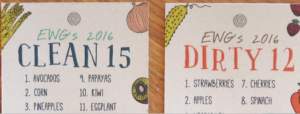
There is a brilliant little report put out every year by the Environmental Working Group (EWG). It’s called the “Shopper’s Guide to Pesticides in Produce.” They analyze pesticide tests for 48 of the most common fruits and vegetables. They then come up with “The Dirty Dozen” and “The Clean Fifteen“.
Once armed with the “Dirty Dozen” and “Clean Fifteen” lists you can make more informed buying decisions. If you have are looking to cut back on your grocery bill you could buy conventional some of the items from the “Clean Fifteen” list. Similarly, if you want to reduce your pesticide exposure, buy organic items on the “Dirty Dozen” list.
You may be wondering if all this talk of pesticide exposure is reason to be concerned, or just more hoopla.
According to a 2012 report from the American Academy of Pediatrics, it’s a big deal. The report said that children have “unique susceptibilities to [pesticide residues’] potential toxicity.” They cited research that linked pesticide exposures in early life and “pediatric cancers, decreased cognitive function, and behavioral problems.” It advised its members to urge parents to consult “reliable resources that provide information on the relative pesticide content of various fruits and vegetables.”
I’ve seen the effects of pesticide exposure first hand and can assure you, we need to be concerned.
On Christmas Eve 2006, we wet to an orphanage in Mexico, just outside of Ensenada. The mothers of the children had worked picking produce fields when they were pregnant. The disabilities these children experienced were profound. The faces of those sweet children are forever in my memory. As we drove away that day there was a sense of helplessness.
In honor of those sweet children, please familiarize yourself with the Dirty Dozen and try to avoid, minimize, or at least clean really well items on the top of the list.
The key findings showed more than 98% of strawberry samples tested positive for at least one pesticide. Single samples of strawberries tested positive for 17 different pesticides!!! Get the list, you will be surprised!
On the clean side of things, one of my favorites. Only 1% of avocado samples showed any detectable level of pesticides.
Environmental Working Group has done a great job educating consumers about Pesticides and other environmental issues. Consider making a small donation, they will even send you a nifty laminated shopping list of the Dirty Dozen and Clean Fifteen.
Which items on the Dirty Dozen and Clean Fifteen surprised you?